Writing craft
Can Speaking Help Writers Finally Finish Their Books?

Many people do not lack a book idea. They lack a workable way to turn that idea into a finished manuscript.
The unwritten book may already exist in fragments: stories told at dinner, voice notes, lessons repeated to clients, family memories, travel journals or half-finished chapters. The difficulty is often the distance between having something to say and sitting down long enough to type it into book form.
So can speaking help writers finally finish?
Yes - provided we understand what speaking can solve, what it cannot solve, and what must happen after the words have been captured.
Why writers stop before the book is finished
The blank page receives much of the blame, but it is only the first obstacle. Writers also lose momentum because they try to perform several different jobs at once.
They attempt to invent, compose, edit, structure, fact-check and judge every sentence while producing the first draft. A novelist pauses over punctuation before discovering what the scene is about. A memoirist tries to remember events in perfect order. A leadership author polishes an opening before deciding what the reader will learn.
A book is easier to complete when those jobs are separated.
The first task is to create enough genuine material. The next is to shape it. Then the author can test the reader promise, structure, chapter purpose, pacing, evidence, character development or emotional arc. Sentence-level polish matters, but it should not distract from larger problems too early.
This is one of the central editorial principles behind Your Book Pro: development comes before decoration. A polished chapter cannot rescue a book with no clear audience, organising idea or movement. Conversely, a rough spoken transcript may contain a powerful book even when it is not yet elegant prose.
Speaking lowers the cost of beginning
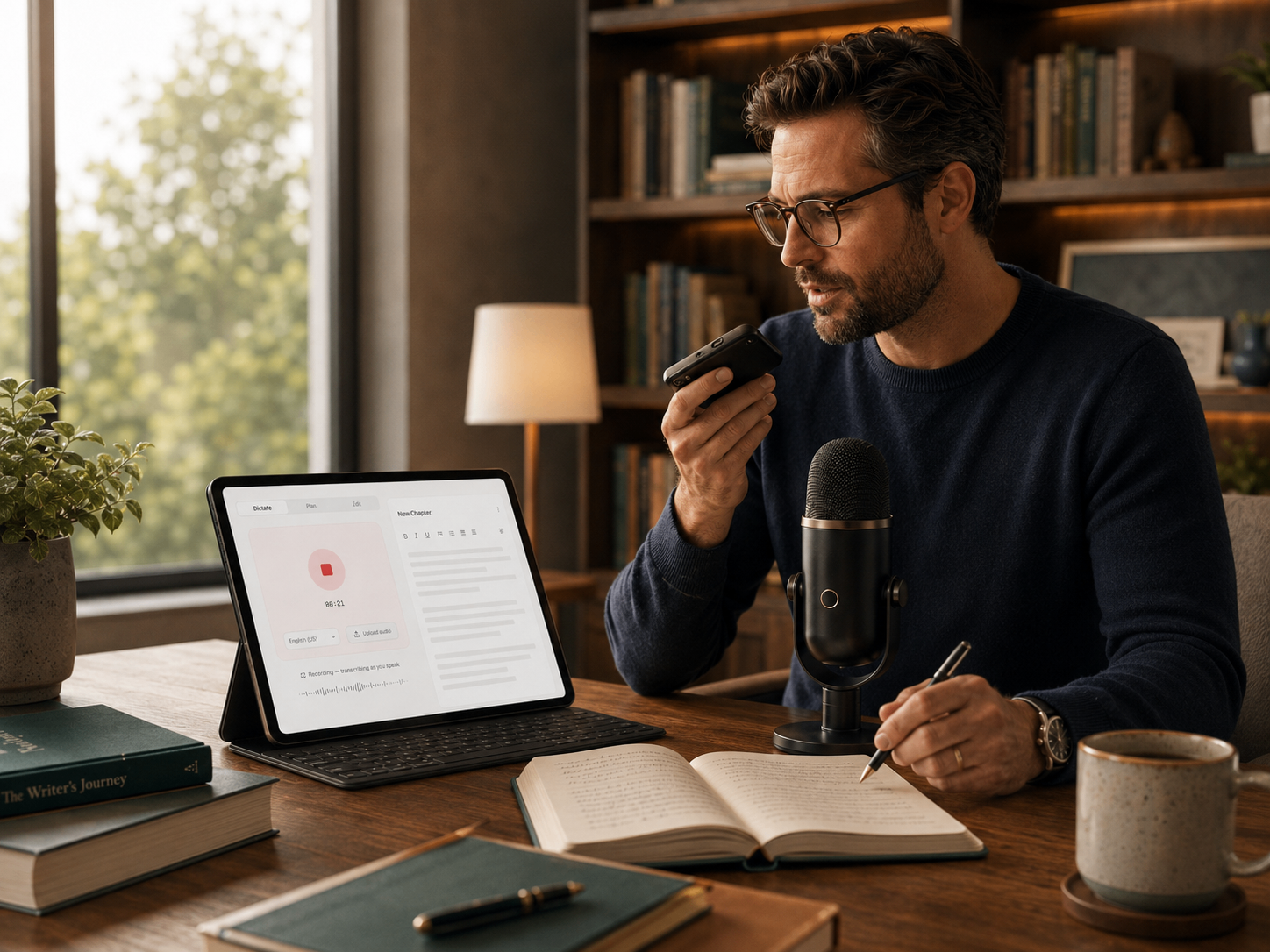
Typing can make writers feel that every sentence is already part of the final manuscript. Speaking feels more provisional. It allows the author to explore.
A memoirist can begin with, “The moment I keep coming back to is…” rather than deciding where Chapter One belongs. A novelist can talk through what a character wants. A non-fiction author can explain an idea to one curious reader. A traveller can capture details that photographs miss.
Memory, dialogue and explanation are often naturally oral. When people speak, they frequently reveal emphasis, sequence and emotion before they have consciously planned them.
Speaking can also be considerably faster than typing. For many authors, dictation can be around three times faster, depending on their speaking and typing speeds. But speed is not the only advantage. A ten-minute recording feels achievable on a day when “write a chapter” does not.
Small, repeatable sessions create manuscripts.
A transcript is raw material, not a finished book
Speaking more words does not automatically produce a better book.
Natural speech contains repetition, false starts, vague references and detours. A transcript may preserve the author’s voice, but it still needs editorial decisions.
What is this book promising the reader? Which material belongs? What should become a scene? Which chapters repeat the same job? What is missing?
For fiction, a promising idea needs an active dramatic engine:
- Who wants what?
- Why now?
- What resists them?
- What changes if they fail?
- Why is this the most interesting period of the character’s life?
Speaking can release scenes and dialogue, but the writer still has to create causality, escalation and change.
For memoir, chronology alone is not enough. The author must decide what the story is really about and which memories support that deeper meaning. A life contains thousands of events; a memoir selects the events that contribute to its emotional spine.
For business or practical non-fiction, spoken expertise must become a clear reader promise, a useful framework, convincing evidence, relevant examples and an ordered journey from problem to outcome.
The aim is not to transcribe everything and call it a book. It is to capture valuable material before it disappears, then shape it deliberately.
How Your Book Pro turns speech into progress
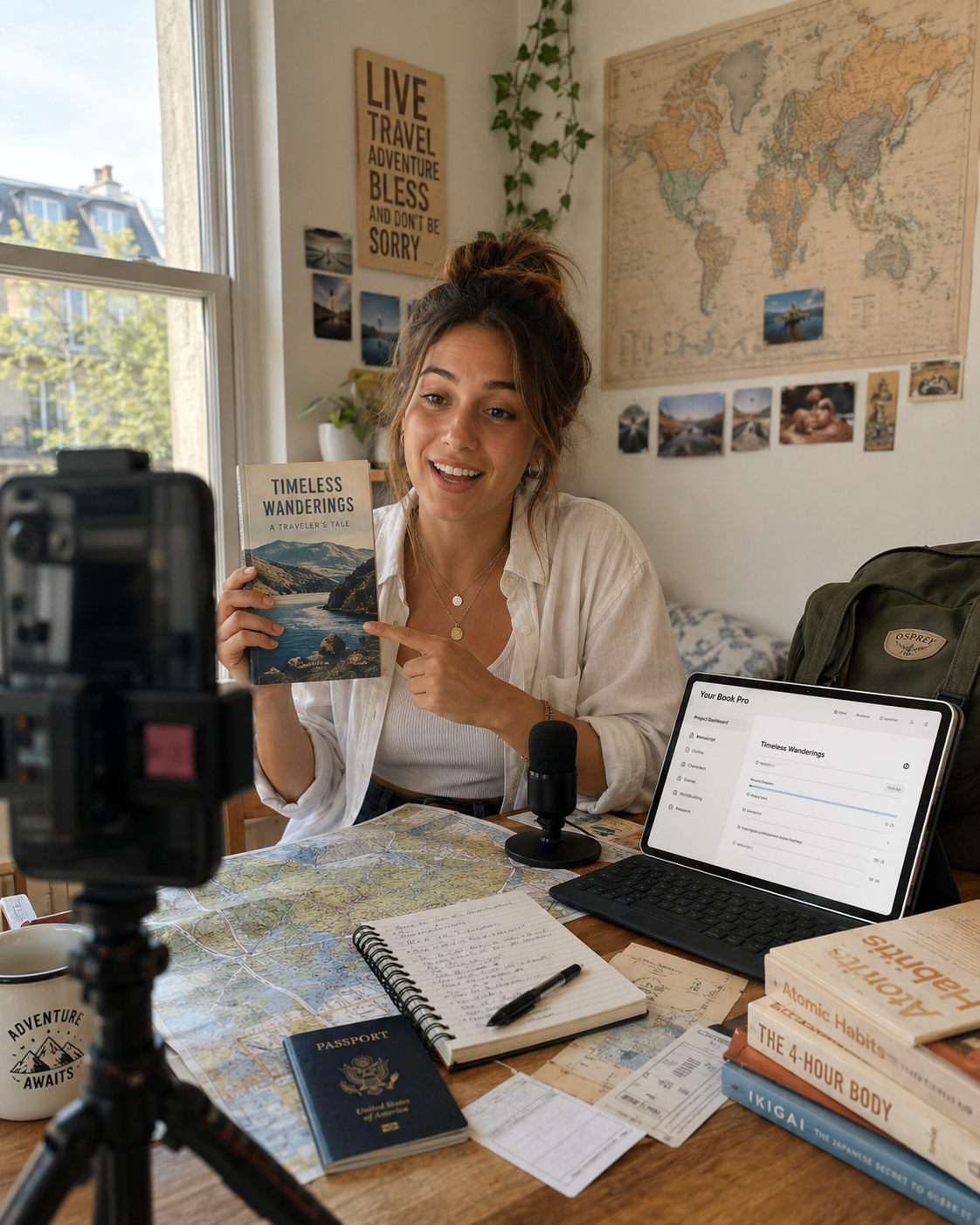
Your Book Pro was built for the gap between having a book inside you and having a manuscript in front of you.
The free voice-first tool lets authors dictate or upload audio and see their own words become editable text. It is built for book-length work, including punctuation, dialogue and material that will eventually become chapters.
The author remains the source of the ideas, experiences, argument and creative choices.
This is not a prompt-to-book generator. It does not replace the writer. It gives the writer a fairer fight.
Once material exists, Your Book Pro helps organise it into a developing manuscript rather than leaving it scattered across notes and recordings.
It also recognises that different books need different questions. A poem is not a textbook. A children’s story needs age fit and read-aloud quality. A screenplay needs scene purpose and dramatic momentum. A memoir needs selection, reflection and emotional truth. A novel needs characters whose choices create consequences.
The Pro Editor then acts as a critical friend. It considers the intended format and reader promise, examines the available manuscript evidence, identifies the highest-impact problems and recommends what to do next.
That last point is crucial.
Generic advice such as “improve the pacing” or “develop the characters” rarely helps a writer finish. Useful feedback must be specific and prioritised.
It might identify that several chapters repeat the same backstory function, that a memoir’s central turning point arrives too late, or that a practical book explains the problem repeatedly without giving the reader a usable method.
A writer does not need one hundred criticisms. A writer needs a path.
Speaking and editing are partners
Some authors worry that dictation will make their writing sound loose or unlike them. It can, if the transcript is treated as final. But first drafts have never needed to be final drafts.
Speaking is a composition method. Revision is where the author decides what the book should become.
A strong workflow is:
- Speak freely enough to capture the material.
- Organise it into scenes, arguments, memories or chapters.
- Test the whole-book structure and reader promise.
- Revise the largest problems first.
- Refine voice, rhythm and sentence clarity once the structure is stable.
- Proofread and prepare the manuscript at the end.
This order protects momentum. There is little value in perfecting individual sentences that may later be removed because the chapter itself is unnecessary.
It also protects the author’s voice. Good editorial guidance should help the writer become clearer and more intentional while remaining recognisably themselves. It should not flatten distinctive language into generic, supposedly “perfect” prose.
The author should still make the decisions. Technology can reveal problems, propose priorities and make the next step visible. It cannot decide what the writer ultimately wants the book to mean.
Who benefits most from voice-first writing?

Speaking is especially useful for people who:
- think more clearly aloud;
- have limited uninterrupted writing time;
- feel intimidated by a blank document;
- have years of expertise but no established writing routine;
- want to preserve memories while they remain vivid;
- hear dialogue and scenes before they can describe them;
- have useful talks, interviews, voice notes or recordings;
- repeatedly begin books but struggle to create enough material to finish (from a travel book to a full novel).
Voice-first writing can also make authorship more inclusive.
People with dyslexia, mobility limitations or other barriers to extended typing may have rich stories, expertise and imaginations without finding a keyboard the easiest way to express them.
The ability to compose orally does not remove the need to think, choose and revise. It removes one mechanical barrier between thought and text.
That distinction matters. Making the means of composition easier does not make authorship less human. Authors have always used different tools: handwriting, typewriters, dictation to secretaries, tape recorders, word processors and professional transcription.
The important question is not whether the author typed every letter. It is whether the ideas, experiences, language, creative choices and final judgement belong to the author.
Will speaking finally make you finish?
Speaking cannot supply commitment, judgement or patience.
It cannot decide what matters most in your life story, solve a passive plot, prove a business claim or make every chapter necessary. It cannot turn an unexamined collection of memories into a meaningful memoir simply by transcribing them.
But it can make beginning easier, sessions more achievable and raw material more plentiful.
It can help a novelist capture a scene while it is alive, a traveller preserve an encounter before its detail fades, a leadership author explain a framework naturally, or a grandparent record a story their family might otherwise lose.
Combined with structure, honest feedback and a visible next step, that can change the odds considerably.
The blank page is optional. The work of authorship is not.
Your voice can produce the first draft. Your judgement shapes the book. The right tools can help you keep moving until “I have an idea” becomes “I have a manuscript.”
Speak your book into existence
Start with one memory, one scene, one lesson or one question.
Do not worry yet about whether it belongs in Chapter One. Speak for ten minutes and see what is already there.
Your Book Pro lets you begin free, using your own voice and your own words. You can then organise the material into chapters and use Pro editorial guidance when you are ready to strengthen the manuscript.