The ultimate guide
How to write a book
Everything from a first idea to a finished manuscript: how to find your subject, build a chapter spine, draft fast by speaking rather than typing, shape the transcript into real chapters, edit it and prepare it for readers. Then pick the genre guide that matches your book.
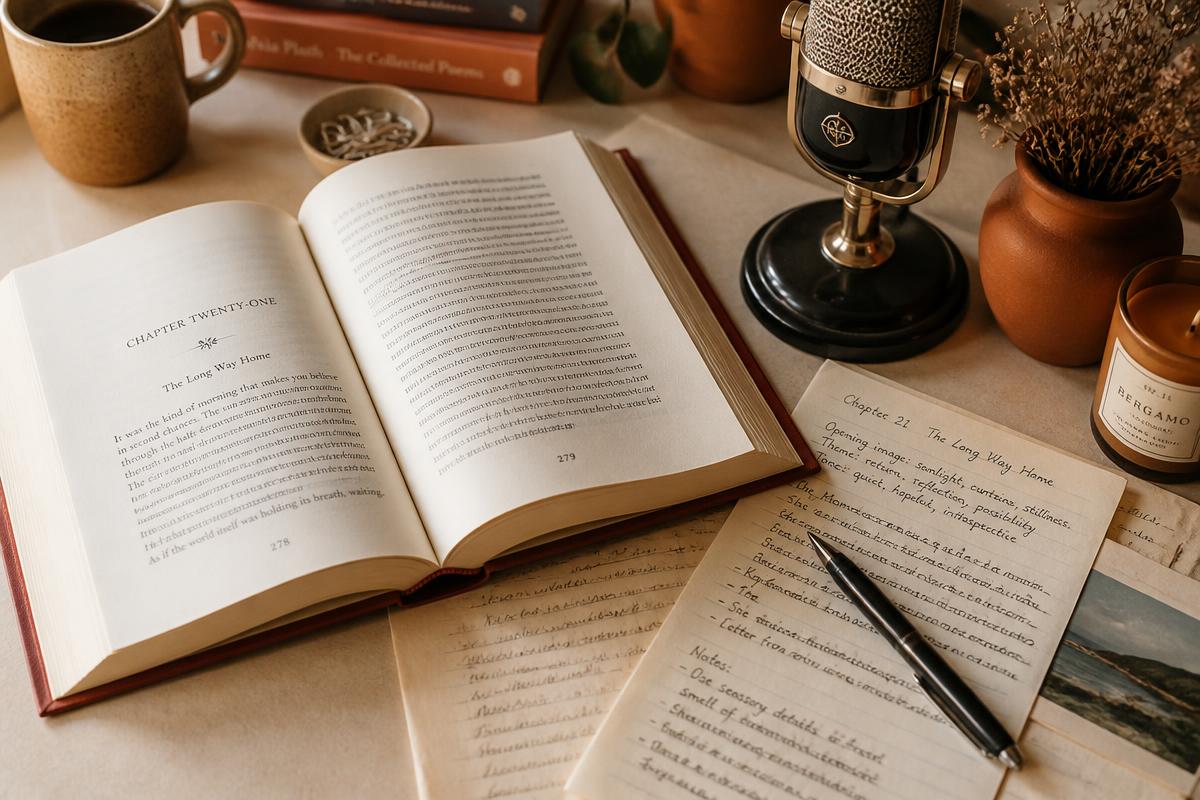
Why most books never get finished
It is rarely a lack of ideas. People who want to write a book usually have the story, the argument or the expertise already - they have told it dozens of times out loud. What stops them is the blank page: the moment where every sentence has to be right before the next one can exist.
The fix is to separate the two jobs that writing quietly forces you to do at once. Getting the material out is one job. Making it good is a different one. Do them in that order and a book becomes a sequence of small, finishable tasks rather than one enormous act of will.
The nine steps, end to end
1. Decide what your book is really about
Before structure, before word counts, you need one sentence you can say out loud: what this book is, who it is for, and what changes for the reader by the end. If you cannot say it in a breath, the draft will wander. Most stalled books are not badly written - they are unclear about their promise.
2. Choose the book type before the outline
A memoir, a novel, a leadership book and a textbook are built from different materials. Picking the form early tells you what a chapter is, how long it should be, and what readers expect. Each genre guide further down this page sets out those conventions in detail.
3. Gather your raw material
You almost certainly know more than a blank page suggests. Notes, talks, voice memos, podcast episodes, journal entries, half-finished documents - collect it all before you start drafting. Raw material beats inspiration every time.
4. Build a rough chapter spine
Ten to twenty one-line chapter descriptions is enough. A spine is not a contract; it is a route you can change. Its real job is to stop you re-deciding the shape of the book every time you sit down.
5. Draft fast - and speak it if you can
Speaking is roughly three to four times faster than typing, and it bypasses the inner editor that freezes people mid-sentence. Talk through one chapter at a time as if explaining it to a friend, then let transcription turn it into text. A messy spoken draft is worth far more than a perfect first paragraph.
6. Shape the transcript into chapters
Dictation produces long, unbroken text. The shaping stage is where you cut it into chapters, reorder scenes or arguments, drop repetition and fill obvious gaps. This is structural work, not line editing - resist the urge to polish sentences yet.
7. Edit for the reader, not for yourself
Now go line by line. Cut throat-clearing openings, tighten the middle, and check every chapter earns its place. Read passages aloud: if a sentence is hard to say, it is hard to read.
8. Get honest feedback before you publish
Structural feedback first (does the book hold together?), then line feedback (does the prose work?). Editorial feedback that names the specific problem is worth more than praise, and far cheaper before you typeset than after.
9. Prepare and publish
Title, blurb, front and back matter, a clean export, then a route to market: traditional submission, an agent, or self-publishing. Each has different timelines and economics - the publishing guide below covers the realistic options.
Writing a book by speaking it
Dictation is the single biggest change most stuck writers can make. You already know how to explain your book - you do it whenever someone asks what it is about. Speaking keeps that natural voice, and it moves at the speed of thought instead of the speed of your hands.
Dictate
Talk through a chapter at a time; transcription turns it into text as you go.
Write
Type directly when you prefer, or edit the transcript in place.
Upload
Bring in podcasts, talks and old voice memos as source material.
Your Book Pro is built around exactly this order of work - speak or upload your material, let it be shaped into chapters, get editorial feedback, then export a finished manuscript. See the full walkthrough.
Now pick your book type
The steps above apply to every book. What changes is chapter shape, length and reader expectation. These guides go deep on each.
Frequently asked questions
How long does it take to write a book?
A first draft of 50,000-80,000 words typically takes three to nine months of consistent work. Authors who dictate often reach a complete draft faster, because speaking produces around 100-150 usable words a minute against 30-40 for typing. Editing and preparation usually take as long again.
How many words should a book be?
Novels usually run 70,000-100,000 words; memoirs 60,000-90,000; business and non-fiction books 40,000-60,000; children's picture books under 1,000. Pick the range for your genre before drafting, so structure and pace are built for the right length.
Do I need an outline before I start?
You need a spine, not a full outline. Ten to twenty one-line chapter descriptions give you enough direction to draft without locking the book in. Many authors discover the real structure only after speaking a rough draft of the first few chapters.
Can I really write a book by speaking it?
Yes - a growing number of published books begin as dictation. Speaking gets the material out; the work of turning that transcript into chapters, tightening the prose and checking structure still belongs to you. What changes is that you edit something real instead of staring at an empty page.
What is the hardest part of writing a book?
Finishing the first draft. Most books that never appear stall in the middle, when the opening excitement has gone and the ending is still distant. Short, regular sessions with a clear next chapter in mind beat rare, heroic ones.
Should I self-publish or find a publisher?
Self-publishing gives speed and control with higher per-copy royalties; traditional publishing gives editorial support, distribution and an advance, but takes far longer and is competitive. The right answer depends on your goal for the book rather than its quality.
Start your book today - out loud
You do not need an outline, a title or a free weekend. Speak one chapter and see what you already have.