For church leaders
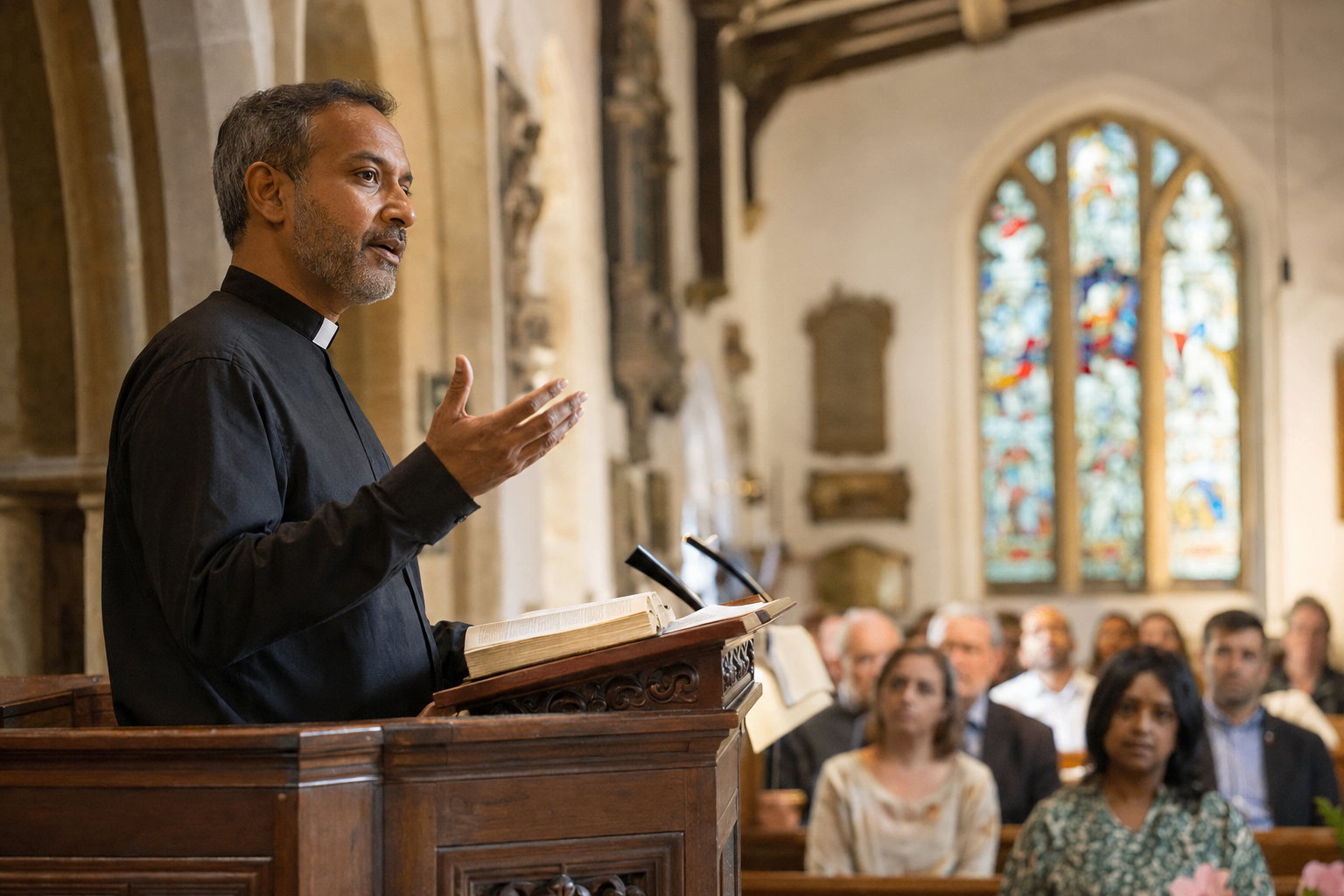
Your sermons may already contain your book.
Twenty years of preaching is a body of thought, not a filing cabinet. Bring in your recordings or your manuscripts, find the themes you have returned to across a ministry, and shape them into a book your congregation can hold - with every quotation of Scripture checked against a verified source rather than taken on trust.
Quick facts
- What it is
- A way to turn sermons and sermon recordings into source material for a book.
- Best for
- Preachers and church leaders with an archive of sermons, recordings, notes or manuscripts they would like to shape into a book.
- What it does
- Transcribes recordings, identifies themes across an archive, helps shape a chapter structure, and checks scripture citations - while you remain responsible for the book itself.
- What it does not do
- It does not simply publish a sermon archive unchanged.
The church offer
Start free on Plus with 1,000 welcome credits that never expire. Every Pro account includes ten hours of sermon audio.
Each recording can run up to an hour. Sermon manuscripts, notes and outlines uploaded as documents do not use audio capacity at all and are not capped, so if you preach from a full script you can bring in as many as you like.
Past the included hours you can add more audio with credits, without leaving the plan.
Find the book in your sermon archive
Your summary is built from your church's public sermon feed. You don't need to know what RSS is - just paste in the feed address. If you don't know it, you can usually find it by searching for your church or sermon podcast here: Find my feed.
From sermons to a finished book: how it works
CREATE
Bring in what you already have
Upload sermon audio, or the manuscripts and notes you preached from. Full scripts, bullet outlines and recordings from a Sunday livestream all work, and you can mix them. Your Book Pro transcribes the audio and reads the documents, keeping each sermon identifiable by date and title. Documents are unlimited. If you preach from a full manuscript, bring in as many years as you have.
- Audio, documents or feed
- Transcribed and dated
- Original audio kept
SHAPE
Find the themes, not the calendar
A sermon archive is organised by the church year. A book is organised by argument. Your Book Pro groups what you have said across seasons and years, so a decade of preaching on grief becomes one coherent thread rather than forty-one separate Sundays. As material moves into chapters, each passage keeps a record of the sermon it came from.
- Themes across years
- A chapter plan you can challenge
- Provenance preserved
IMPROVE
Add what was never preached
Every archive has gaps. A sermon assumes a congregation that was there last week; a reader arrives with nothing. Dictate the memories, context and new teaching that were never said aloud, and use editorial feedback, Beta Readers and Proof Read on what results.
- Dictate new material
- Editorial feedback
- Beta Readers and Proof Read
PREPARE
Print it for the people who heard it first
Prepare the manuscript for publication, or order a small print run for a study group, a bereavement ministry or the back of church. Your first readers are already in the building.
- Publishing preparation
- Small-batch print runs
- Your congregation first
Finding your sermon recordings
Your Book Pro takes audio files and podcast feeds. It cannot pull audio from a YouTube or Facebook video link, but you rarely need it to.
If your church publishes sermons as a podcast, connect that feed and choose the episodes you want. Many church media platforms generate a podcast feed automatically, so it may exist even if nobody set it up deliberately - worth asking whoever runs your media or AV.
Otherwise, the original recording is usually still on the machine that made it: the sound desk, the recorder, the laptop running the stream. That file is better quality than anything published afterwards, which matters, because clearer audio produces a more accurate transcript and fewer misheard verses.
One more thing worth doing: upload the sermon rather than the whole service. A ninety-minute recording of notices, worship and prayers uses two credits and gives Your Book Pro forty minutes of material it cannot use.
Quotation checking
A verse misheard is a verse printed
Transcription is where preaching goes wrong on the way to print. A verse heard slightly wrong by a transcriber does not announce itself. It reads perfectly well, it sounds like Scripture, and it can travel unchallenged from a Sunday morning into a finished book.
Your Book Pro does not take a quotation on trust, and it does not ask a language model whether a verse looks right. It identifies quoted material - direct quotations, block quotes, Bible references, remembered phrasing, close paraphrases, allusions, prayers, creeds, hymns, liturgy and historical quotations - including where you never gave a reference at all, and including the sermon habit of saying "Scripture says" and carrying on.
It then compares what you said against a verified source, and tells you which of these it is: an exact quotation, the right verse slightly mistranscribed, the right idea but actually your paraphrase, wording that belongs to a different translation, a probable misattribution, or something it cannot verify and will not pretend to have checked.
It will not correct you quietly
When something needs changing, Your Book Pro keeps four things separately: what you originally said, what the verified source actually reads, what it proposes, and what you finally approve. Nothing is silently repaired in your manuscript.
That matters most with audio. If a transcription altered a verse, you should be able to see exactly what happened rather than finding a tidy correction that no longer matches what you preached - or, worse, one that matches nothing at all.
Scripture, commentary and your own interpretation are different things
In the pulpit these blend, legitimately. You read a text, you draw on a commentary, you explain what you believe it means, and the congregation follows without needing the seams pointed out.
A book cannot do that. A reader who cannot tell your interpretation from the text is being misled, however unintentionally.
Your Book Pro treats them as distinct layers: the sacred text itself, the translation you are quoting, published commentary, theological interpretation, liturgy, historical documents, and your own paraphrase. It will not let commentary be presented as Scripture, or a modern translation stand in for the ancient source.
Which translation, and whose licence
Verification runs against openly licensed texts held locally - the World English Bible British Edition, the Berean Standard Bible and the Open English Bible Commonwealth edition.
Proprietary translations are handled differently, because we respect their licences. Your Book Pro can identify the reference and tell you when your wording belongs to a translation it cannot hold a copy of, which is precisely the moment to check what permission your book needs. Depending on the source, verification may run against a licensed service, a read-only reference, an edition you supply yourself for use in your project alone, or a specialist review where automated checking would be inappropriate.
Most modern translations set a limit on how much you may quote before written permission is required, along with a copyright notice the book must carry, and the terms differ between publishers. Confirming that with your translation's publisher remains your responsibility. What Your Book Pro can do is make sure you know what you have quoted, and from where, before you ask.
Four questions, asked separately
A quotation can be accurate and still be a problem. Your Book Pro keeps four questions apart, because passing one does not settle the others:
- Is the wording accurate?
- Is it attributed to the right source?
- Is it the translation or edition you think it is?
- Are the rights, the context and the confidentiality acceptable?
The fourth is the one that catches people out, and it is the one a sermon archive raises most often.
What was said in confidence should stay that way
Sermon illustrations are full of people. A marriage that nearly ended. A diagnosis. A conversation in a hospital corridor. Spoken to a congregation who knew the context and the boundaries, that is pastoral. Printed and sold to strangers, it can identify someone who never agreed to be in a book.
Your Book Pro asks you to name the contributors on any recording before their words are quoted, and records what each has agreed to. Confidentiality is one of the four gates a passage has to clear, so a story that needs permission is raised rather than assumed.
The decision is yours. It should be made deliberately, chapter by chapter, while the book is still a draft and permission or anonymity is still easy to arrange.
Where preaching borrows
Preaching absorbs material. A commentary read years ago, an illustration heard at a conference, a phrase from a study guide that became your own through repetition. In the pulpit that is ordinary. In a printed book it is a problem, and sermon plagiarism has ended ministries.
Your Book Pro flags unattributed quotations, close paraphrases, explanations reproduced too closely and material whose source is unclear, and it keeps your research separate from your manuscript so that background reading does not quietly become your prose.
It is not a similarity scan of the internet, and we will not pretend otherwise. It cannot know what you read in 2009. What it can do is make it difficult to publish something you have not looked at properly.
Nothing unresolved is called finished
A significant quotation that remains unidentified, unverified, uncertain as to edition, or waiting on specialist review does not quietly disappear as a book approaches completion. It is recorded as unresolved, and it stays unresolved until you or an appropriate reviewer settles it.
A book can be finished. A quotation cannot be left hoping.
How many sermons should you bring?
Fewer than you have. A minister preaching weekly for twenty years has around a thousand sermons, and uploading all of them would bury the themes rather than reveal them.
Start with a series you know worked, or the sermons you have been asked for copies of. Ten to fifteen is usually enough to see the shape of a book, and that sits inside the ten hours of sermon audio a Pro account includes. Your Book Pro tells you what the material has not yet covered, so it is easy to come back and add more.
It cannot tell you which sermons to leave out. That judgement is yours, and it is the most valuable thing you bring to this.
What that looks like in practice
Say you have preached at eleven funerals over six years, plus an Advent series on waiting and a mid-week talk on Job you were never happy with.
Your Book Pro reads across them and finds you have been making the same argument about grief and time for years without noticing - in different words, to different families, from different texts. That becomes a chapter with a job to do.
It also tells you what is missing. Usually the part you never had to say from the pulpit, because everyone present already knew it.
What kind of book is in there?
Spoken material is the source, not the genre. A sermon archive can support several very different books.
A daily devotional, where short readings suit a preaching archive better than almost any other form
A study guide for small groups, with discussion questions the sermons already answered
A book on one subject you have returned to for years: grief, money, marriage, doubt, forgiveness
A seasonal book for Lent or Advent
A memoir of ministry, and of the community that shaped it
The teaching book your congregation keeps asking you to write
On writing your own book
There is an active argument in the church about preaching written by machine, and we are on the same side of it as you.
Your Book Pro does not write your book. It reads what you have already said, tells you what it finds, and proposes structure. Nothing reaches your manuscript that you did not write, dictate or approve, and drafted text is marked in red italics until you accept it.
It also includes an AI footprint check. This reads the finished manuscript and estimates how much of it is likely to strike a reader as machine-written, showing you the specific passages responsible and why - a stretch of summary where the detail dropped away, an abstract phrase that could have been said by anyone. It is an estimate of how your book will be read, not a judgement on how it was written, and zero per cent is not the target.
For most authors that is a commercial concern. For a preacher it is closer to a pastoral one. Your authority rests on people believing that the words are yours, and a congregation who suspect otherwise will not say so - they will simply stop trusting the book.
C. S. Lewis turned wartime radio talks into Mere Christianity. Martin Luther King Jr. assembled Strength to Love from sermons, and was clear that preaching had to be redesigned before it could be read.
Want to see every screen before you begin? The recordings wizard is documented in full, step by step.
Your congregation has already heard the book.
Bring in a sermon series and see what is in it. Every Pro account includes ten hours of sermon audio, and sermon documents are unlimited.
Your Book Pro is an independent product. It is not affiliated with any church, denomination or Bible publisher, and it does not provide legal or copyright advice. Verification is offered as editorial support, not as theological or legal clearance. The same tools work for teaching and preaching in any faith tradition.